History
In 1975, the first American course with Lama Yeshe and Lama Zopa Rinpoche was held at Lake Arrowhead in California. During the retreat, Lama Yeshe was asked what would be a good name for a center in California. Lama immediately said “Vajrapani Institute for Wisdom Culture.”
As more students gathered and more teachings were given, the students were inspired to make it happen. In 1977, thirty acres of land in the Santa Cruz Mountains were donated for a center and Vajrapani Institute for Wisdom Culture was born.
In December 1978, students began to arrive on the land with only the clothes on their backs and their faith in the Lamas. In Volkswagens and mobile homes, people came with their families to live in tipis and shacks made of carpet remnants so that they could build a thriving center.
Eventually enough money was raised to purchase a sawmill and slowly the work of building the center began. Because construction work occurred in-between students’ day jobs and family responsibilities, progress on the center moved slowly.
By 1983, the students had obtained the now 75 acres of land and finished building the gompa, complete with a commercial kitchen, dining room, offices, and library. In 1984, Lama Yeshe came back to Vajrapani Institute one last time, to leave his body behind. At the death and cremation of Lama Yeshe, construction of his “Enlightenment Stupa” began and was completed in a few years.
In 1994, after a large earthquake in 1989, California state relief money helped fund the completion of six private retreat cabins and a bathhouse on the ridge near Lama Yeshe’s cremation site. Recently in 2010, Lama Yeshe’s cremation Stupa, constructed on the site of his cremation, was completed.
Lineage and Teachers
Vajrapani Institute is affiliated with the Foundation for the Preservation of the Mahayana Tradition (FPMT), an international, non-profit organization, devoted to the transmission of the Mahayana Buddhist tradition and values worldwide through teaching, meditation, and community service. FPMT projects include: meditation and teaching centers in 36 countries, monasteries and nunneries in 6 countries, prison outreach, leprosy clinics, polio clinics, health and nutrition clinics, hospices, publishing houses, and schools teaching universal education.
The FPMT organization is based on the Gelug Buddhist tradition of Lama Tsong Khapa as taught by FPMT’s founder, Lama Thubten Yeshe and its spiritual director, Lama Thubten Zopa Rinpoche. The organization strives to follow the example and inspiration of His Holiness the Dalai Lama in his compassionate service to humanity.
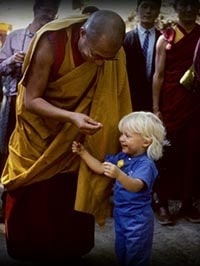
“…I would like to thank all the people working in (Lama Zopa) Rinpoche’s organization… I would like to request you to continue. Rinpoche works with such determination and great sincerity in the service of Buddha’s teachings and sentient beings, it’s important that we all combine our efforts…”
– His Holiness the Dalai Lama
The Gelug Buddhist tradition traces its lineage, teacher to student, back to the ancient university of Nalanda in India. Every one of our teachers must be approved by Lama Zopa Rinpoche and the International Office of the FPMT. This ensures that every teaching given at Vajrapani Institute, as well as the other FPMT centers worldwide, is pure and correct within the Gelug tradition.
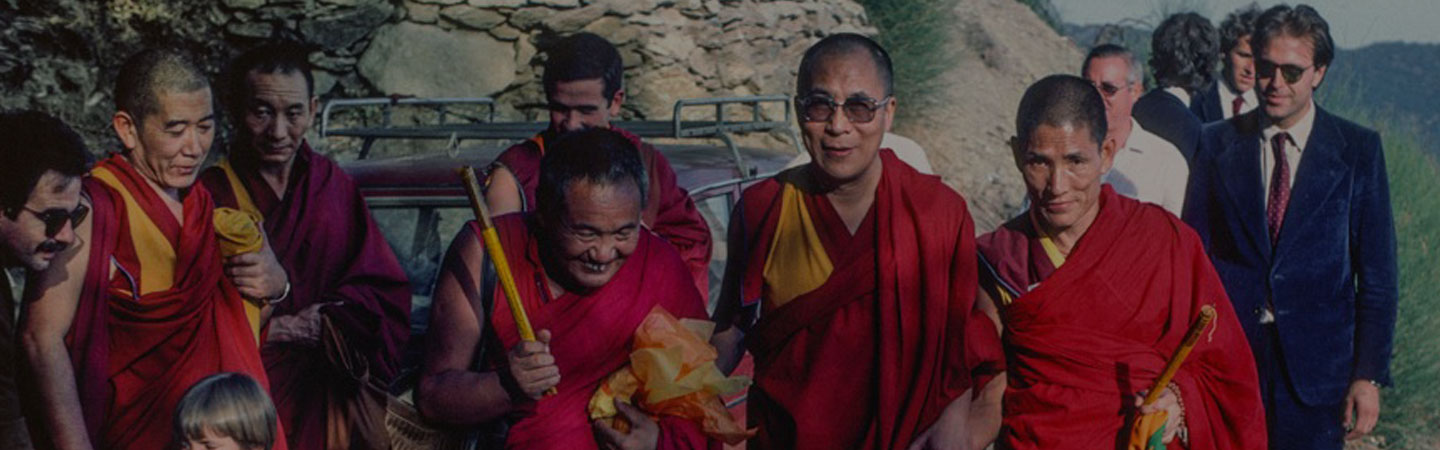
Because Vajrapani Institute was one of the first Tibetan Buddhist Dharma centers in America, it has had the privilege of hosting many great Tibetan Masters, such as:
His Holiness the 14th Dalai Lama, His Eminence the 7th Ling Rinpoche, His Holiness Zong Rinpoche, Deshung Rinpoche, Tara Rinpoche, Lati Rinpoche, Geshe Nawang Dhargye, Zasep Tulku, Kirti Tsenshab Rinpoche, Geshe Sopa, Geshe Gyeltsen, Lama Kunga, Jetsun Kuchula, Choden Rinpoche, Jangtse Choje Lobsang Tenzin Rinpoche, Yangsi Rinpoche, and Gyumed Khensur Rinpoche Lobsang Jampa.
While many of these great teachers are no longer with us, many of them are and continue to visit the center to this day. The blessings that each of them leave behind are felt by all who come to visit our sacred and tranquil land.